A lunar base is not a building in isolation. It is a network of landing systems, power generation and storage, communications, mobility, payloads, thermal control, logistics, and human or autonomous operations. The engineering question is how those parts behave together as the surface system grows.
That makes lunar surface systems a natural application for mission-first system simulation. The useful first step is to make the interactions that affect a mission decision executable early enough to guide the next design step, while detailed habitat, life-support, structural, and qualification models remain available for the questions they answer best.
Start with the surface decision
“Can we build a lunar base?” is too broad to simulate usefully. A better study begins with a decision such as:
- Can a rover deliver a payload between the landing site and a power or habitat node?
- Does the surface power network support the planned vehicle and payload schedule?
- What happens to operations when a relay, vehicle, or energy source is unavailable?
- Which activities must move because of thermal or lighting constraints?
- What telemetry and operator actions are required to keep the system inside its margins?
The system model is then scoped around the decision. Some questions need terrain and vehicle contact. Others need power, storage, loads, and scheduling. A long-duration study may need thermal state and communications windows. The model grows with the question instead of becoming an unreviewable attempt to reproduce an entire programme.
Why surface infrastructure creates integration problems
A surface asset changes the conditions for other assets. A rover consumes energy while moving and may generate heat that changes its duty cycle. A payload creates a load and a communications demand. A relay changes what an operator can observe. A lander or power node changes where vehicles can safely operate. The operating plan determines when each of those effects matters.
Separate discipline studies can capture each local behaviour, but the mission still needs an answer about sequence and interaction. That is where systems engineering and co-simulation meet: the architecture must preserve the meaning of the connections, the timing of exchanges, and the identity of the components involved.
A lunar surface model is a growing graph
Representing the surface system as a connected graph gives the team a way to add capability without rewriting the runtime mechanism:
- Nodes represent vehicles, power sources, storage, payloads, relays, sensors, and operational actors.
- Ports describe the quantities and commands that can cross a boundary.
- Connections describe power, thermal, mechanical, data, or mission relationships.
- Events describe operational facts such as arrival, low energy, loss of link, or touchdown.
- Scenarios describe what the mission does in response to those facts.
In LunCoSim, OpenUSD carries the composed scene and topology. Modelica carries continuous physical equations where they belong. Rigid-body physics handles motion and contact. Rhai carries mission policy. Telemetry and diagnostics expose the evidence generated by the assembled run.
How LunCoSim contributes to the study
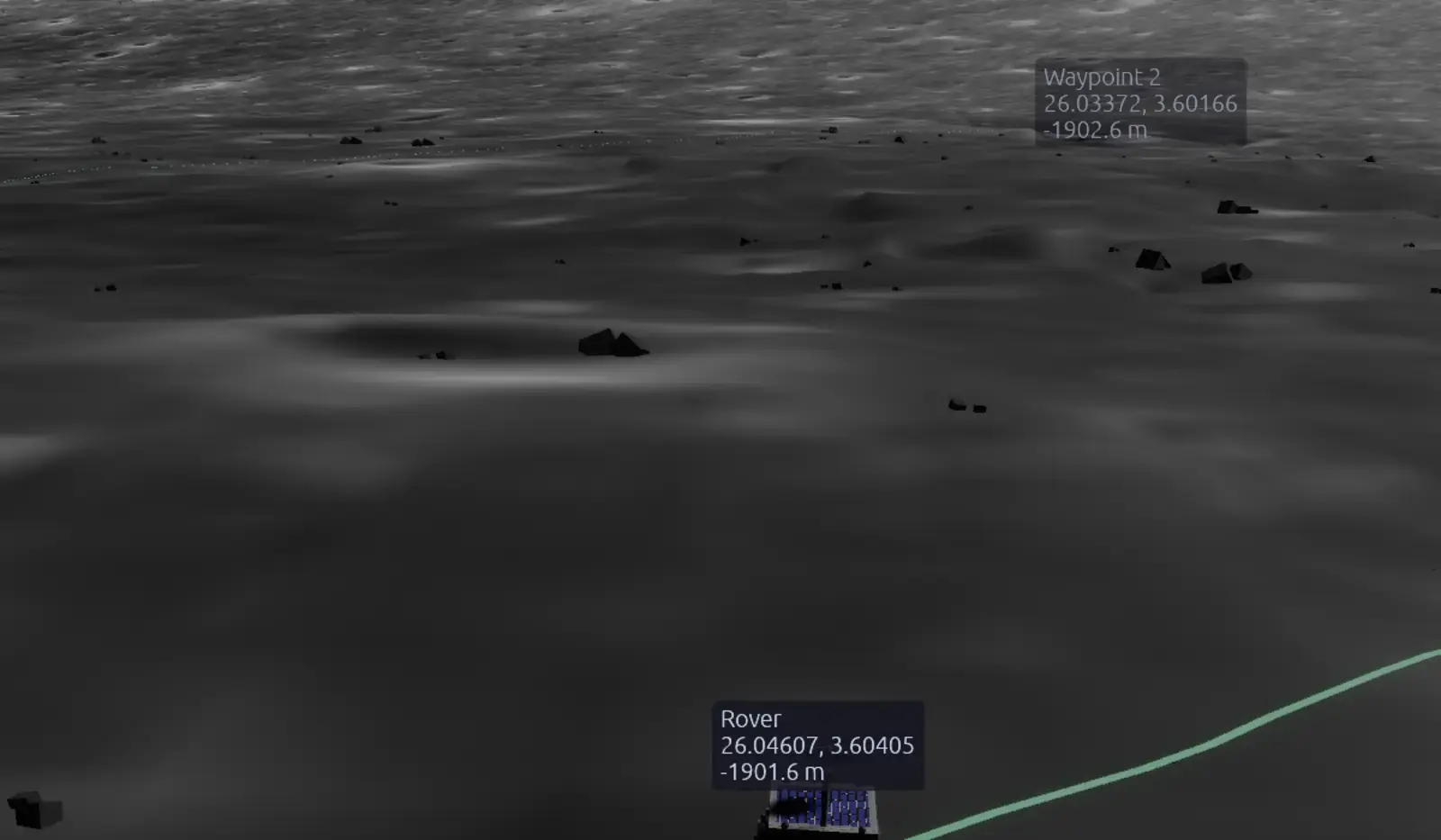
LunCoSim is strongest where a lunar surface question depends on connected robotics and mission behaviour: terrain-aware mobility, vehicle dynamics, power and thermal components, sensors, control, event-driven scenarios, and API-observable state. A rover can therefore be studied as part of a surface operation rather than as a vehicle detached from its resources and operators.
The space robotics simulation page explains the general platform boundary. The rover workflow shows how traverse, mobility, power, and autonomy become one decision. The mission operations workflow covers the scenario and operator side.
What belongs in a later surface-systems study
A mature lunar infrastructure model can grow to include detailed habitat and environmental-control models, surface construction, resource extraction, long-duration logistics, communications networks, and human factors. Each addition needs an authored model, a defined interface, and evidence that the runtime path works.
A useful study models the part of the surface system that changes the decision and identifies the next model or test required to reduce uncertainty. The result becomes an evolving source of system knowledge that can guide design reviews, specialist analysis, and operational planning.
The broader opportunity
Lunar bases make the systems problem visible, but the method applies to any connected space infrastructure: a lander delivering a rover, a robot servicing a spacecraft, a payload sharing power and communications, or a fleet coordinating work across a surface site.
That is why LunCoSim should be presented as a platform for space robotics and mission systems. Lunar surface infrastructure is one of the most demanding proof domains and a useful starting point for a broader family of connected space missions.