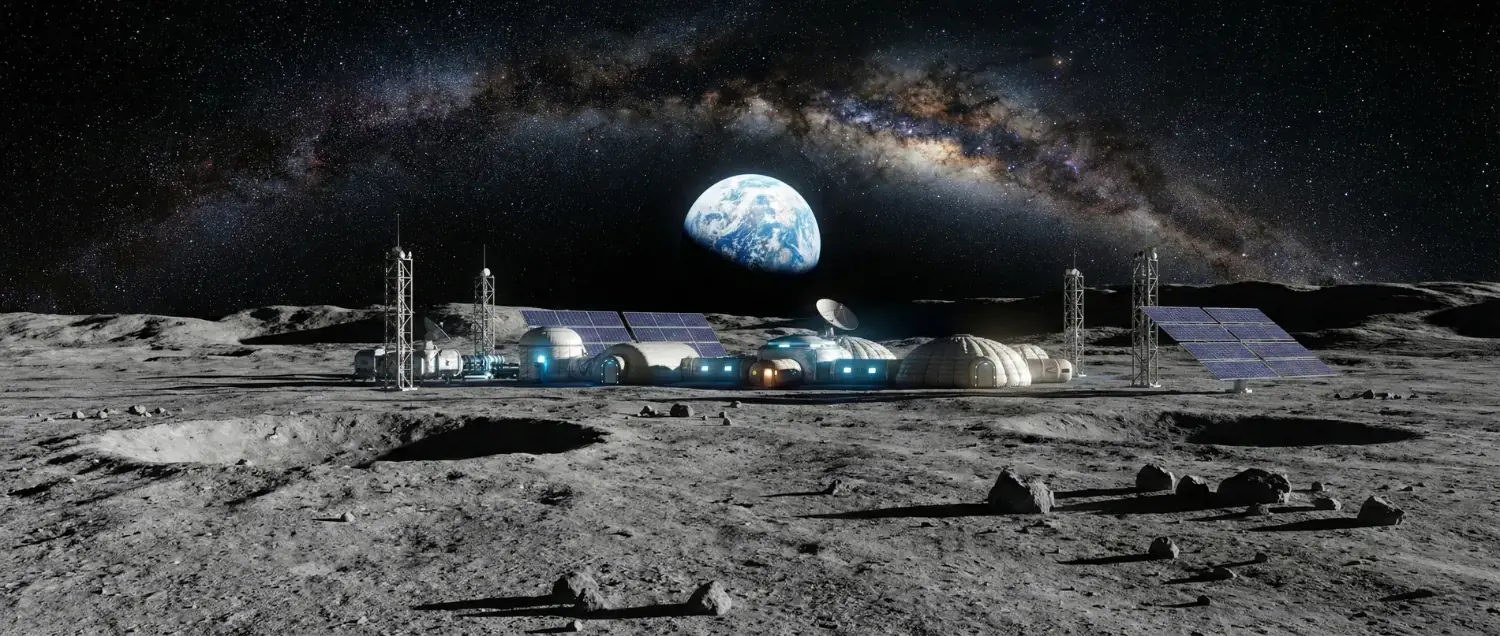
Lunar surface with Earth in background
Open-source mission simulation

LunCoSim

Connect system models, terrain, autonomy, and operations in one executable space-mission study.

The Platform

A connected model
of the mission.

LunCoSim is an open-source space-mission simulator for system-level robotics and multiphysics studies. It models the system of systems around a robot: how the rover drives, draws on the power grid, responds to flight software, uses its thermal margin, and contributes to the overall mission timeline.

The runtime uses a double-precision spatial core so vehicle-scale geometry and large mission frames can remain in one scene. Download the runtime and follow the first-run path when the study needs to move from an idea to an inspectable local model.

Inside the Simulator

A mission view for surface operations.

The simulator brings attitude, navigation, vehicle state, and terrain into one operator view. This example shows a rocker-bogie rover driving across regolith, with telemetry panels updating at 20 Hz from the engine's exposure registry.

LunCoSim — rover surface operations sandbox_view20 Hz● SOLVER
rover_hud.css · view_mode.css · rocker_bogie.usda · rover_surface_ops.rhai
What LunCoSim is for

A mission runtime for connected engineering studies.

Connect physical models and engineering constraints in an interactive runtime. Explore a concept, compare system choices, and rehearse operations before hardware and procedures are fixed.

01

Explore the mission before the hardware exists.

Compose a lunar base or vehicle, run its operations, vary the conditions, and see which requirements need to change before the design is fixed. Choose model detail according to the decision and available compute.

02

Keep the team on one operating state.

Multiple operators can work from the same live scene: one drives the rover, another watches telemetry, and a third tracks the power system. Commands and state remain visible across the session.

03

Change mission policy without rebuilding the runtime.

Attach Rhai mission scenarios—the scripting layer for lifecycle hooks, sensing, timelines, and event responses—to entities. Edit the mission policy and run it again through the same command and observation boundary used by the UI and AI agents.

04

Repeat the study from code or an AI agent.

Use the HTTP/MCP API to drive a run from code, CI, or an AI agent. Compose vehicles in OpenUSD and run headless studies when the same mission question needs to be compared across many cases.

Under the Hood

Compose the domains that change the decision.

LunCoSim connects specialized engines — Modelica, Avian3D, terrain, and mission autonomy — through one authored scenario and explicit runtime boundaries.

Co-simulation

Coupled solvers

Modelica models, rigid-body physics and control scripts exchange named ports on one fixed clock.

OpenUSD

Readable scene composition

OpenUSD carries the authored scene, identity, hierarchy, and topology. USD is the world format, not the simulation engine.

Modelica / ROM

Equation-based behavior

Use Modelica for power, thermal, and other continuous domain models while the runtime connects them to the mission.

WebTransport

Shared live state

Multi-user engineering keeps design, testing, and operation connected to the same scene and telemetry state.

rhai

Mission autonomy

Hot-reloadable per-entity flight software and declarative mission timelines.

HTTP / MCP API

One command surface

The command surface is generated from the engine’s schema, so scripts, CI, and AI agents use the same operations as the application.

GeoTIFF

Terrain data

Georeferenced planetary DEMs with the reference frame declared rather than assumed.

f64 core

Precision across the scene

Double-precision physics and spatial math with a floating origin, so precision holds far from the scene root.

Built on an f64 spatial math foundation for vehicle-scale geometry and planetary mission frames. Rust runtime · Apache 2.0 open source
For engineering studies

Make coupled constraints visible.

Bring thermal behavior, power demand, communication link budgets, trajectory planning, and vehicle response into the study when they affect the decision. Tune model detail to the question, run locally, or scale headless for repeatable comparisons.