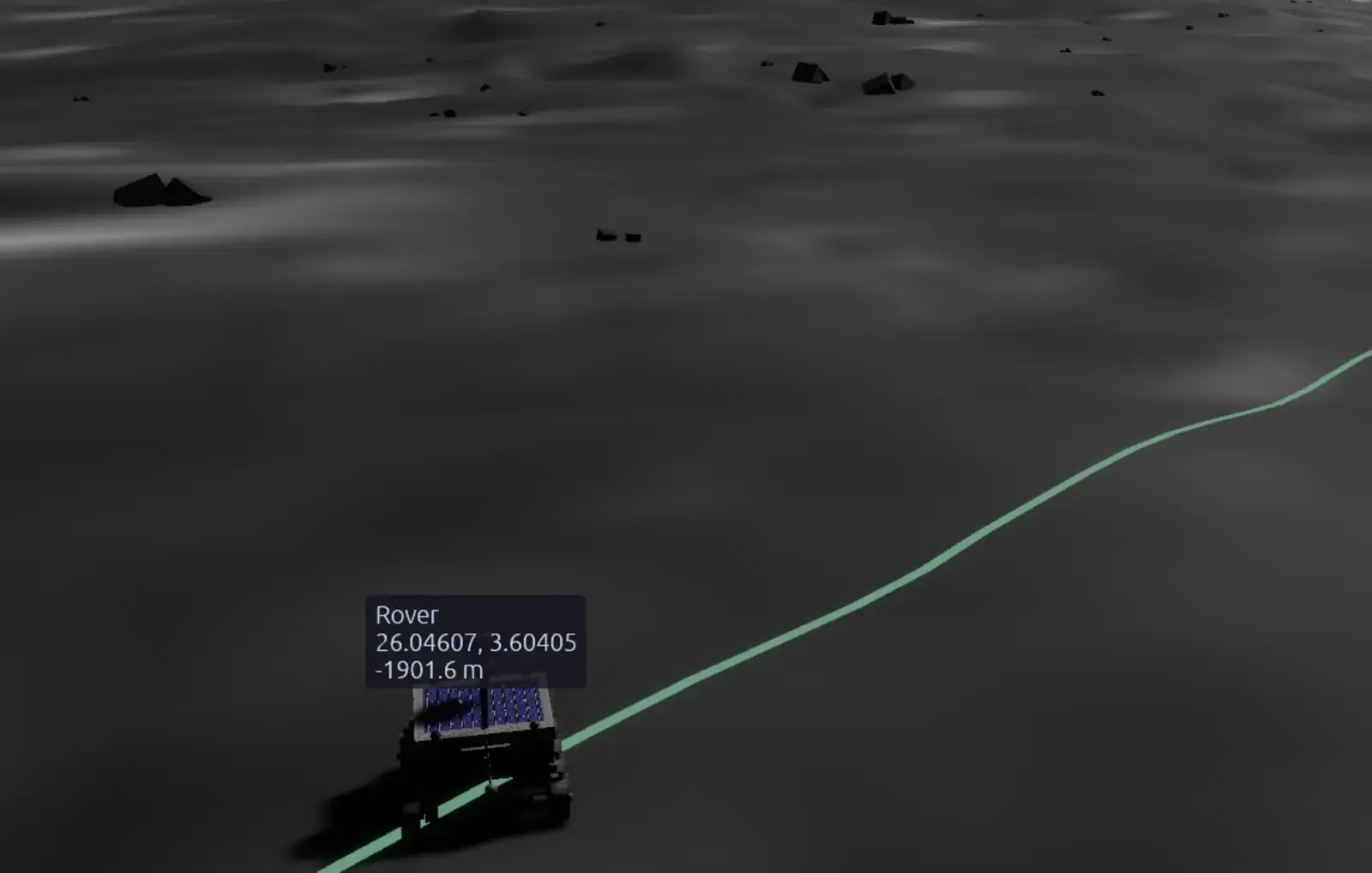
A space robot is successful only when the mission can use it. A rover may have correct wheel dynamics and still fail because its route consumes too much energy, its sensors become unreliable in the lighting conditions, its thermal margin collapses, or the operator cannot recover from a degraded state.
That is why space robotics needs more than a robot simulator. It needs a system-level simulation that connects the robot to the environment, resources, autonomy, communications, and mission procedure that determine the outcome.
The robot is part of a larger system
Robotics teams often begin with a useful, focused question: can the vehicle drive, balance, steer, grasp, or avoid an obstacle? Those questions belong in a dynamics and robotics environment. But mission questions add dependencies:
- How much power does the manoeuvre consume, and what remains for the next activity?
- Does the terrain-induced load change motor heat or traversal time?
- Can the autonomy system act on the sensor data the mission will actually provide?
- What happens when the communication link is delayed or unavailable?
- Can a human operator observe, interrupt, and resume the behaviour?
The useful result is an answer about whether a connected set of capabilities can complete a mission objective. The moving robot is the visible expression of that system question.
Why separate subsystem studies are not enough
Separate studies remain valuable. A specialist dynamics model can answer questions about contact. A power model can answer questions about storage and loads. A thermal model can answer questions about heat transfer. An autonomy test can answer questions about planning.
The failure appears at the seam. A route planner may assume unlimited energy. A power study may use an ideal motor profile. A thermal model may not receive the actual duty cycle. A mission script may use a simplified state that is not the state exposed by the vehicle. Each study can be internally correct while the assembled mission is not.
System-level simulation makes those assumptions explicit and connects the specialist models that change the mission decision. Each detailed model keeps its domain authority while the mission study shows how the domains interact.
What a useful space-robotics model contains
A practical study starts with the decision and selects the smallest set of domains that can affect it:
- Vehicle mechanics: bodies, joints, wheels, forces, contacts, and terrain.
- Resources: battery, generation, loads, propulsion or payload demand.
- Thermal behaviour: heat sources, storage, transfer, and operating limits.
- Sensing and control: the observations and control paths used by autonomy or an operator.
- Mission policy: objectives, tasks, events, handoffs, and recovery actions.
Scope the model to the decision. Fidelity should follow the question. If the question is whether a traverse fits inside an energy budget, a useful resource model matters more than a decorative rendering upgrade. If the question is wheel-soil interaction, terrain and contact assumptions deserve more attention.
How LunCoSim approaches space robotics
LunCoSim composes a mission from authored system definitions. OpenUSD carries the assembled scene and identity. Modelica carries continuous equations for the physical domains that use it. Rigid-body physics carries mechanics and contacts. Rhai carries mission policy. The runtime connects these participants through named ports and exposes state through the same command and query surface used by the UI, scripts, and agents.
That separation matters for robotics. A new vehicle assembly should change the authored topology and parameters, not require a new hard-coded engine wrapper. A new mission sequence should change policy, not duplicate the continuous control law. A result should be traceable to the ports, equations, events, and conditions that produced it.
See the space robotics simulation workflow for the platform view, or start with the rover mission study for a concrete traverse decision.
What this approach helps a team decide
It helps answer questions before hardware or operations make them expensive:
- Which route and vehicle configuration can complete the objective?
- Which subsystem interaction creates the margin loss?
- Should an activity be autonomous, supervised, or manually controlled?
- What telemetry and events must operators see?
- Which specialist model or test should be developed next?
The strongest output is not “the simulator says yes.” It is a better engineering decision: the team knows which assumptions mattered, which evidence is still missing, and what to change next.
Space robotics is the proof domain, not the boundary
Lunar rovers and landers make the need for connected simulation obvious because terrain, power, thermal environment, communications, and operations interact under severe constraints. The same approach can support orbital robotics, payload manipulation, surface infrastructure, autonomous inspection, and other space systems when the relevant models and interfaces are authored.
LunCoSim’s role is to make the system interaction executable and inspectable. It complements detailed specialist analysis and hardware testing by exposing the mission-level consequences of the models the team chooses to connect.