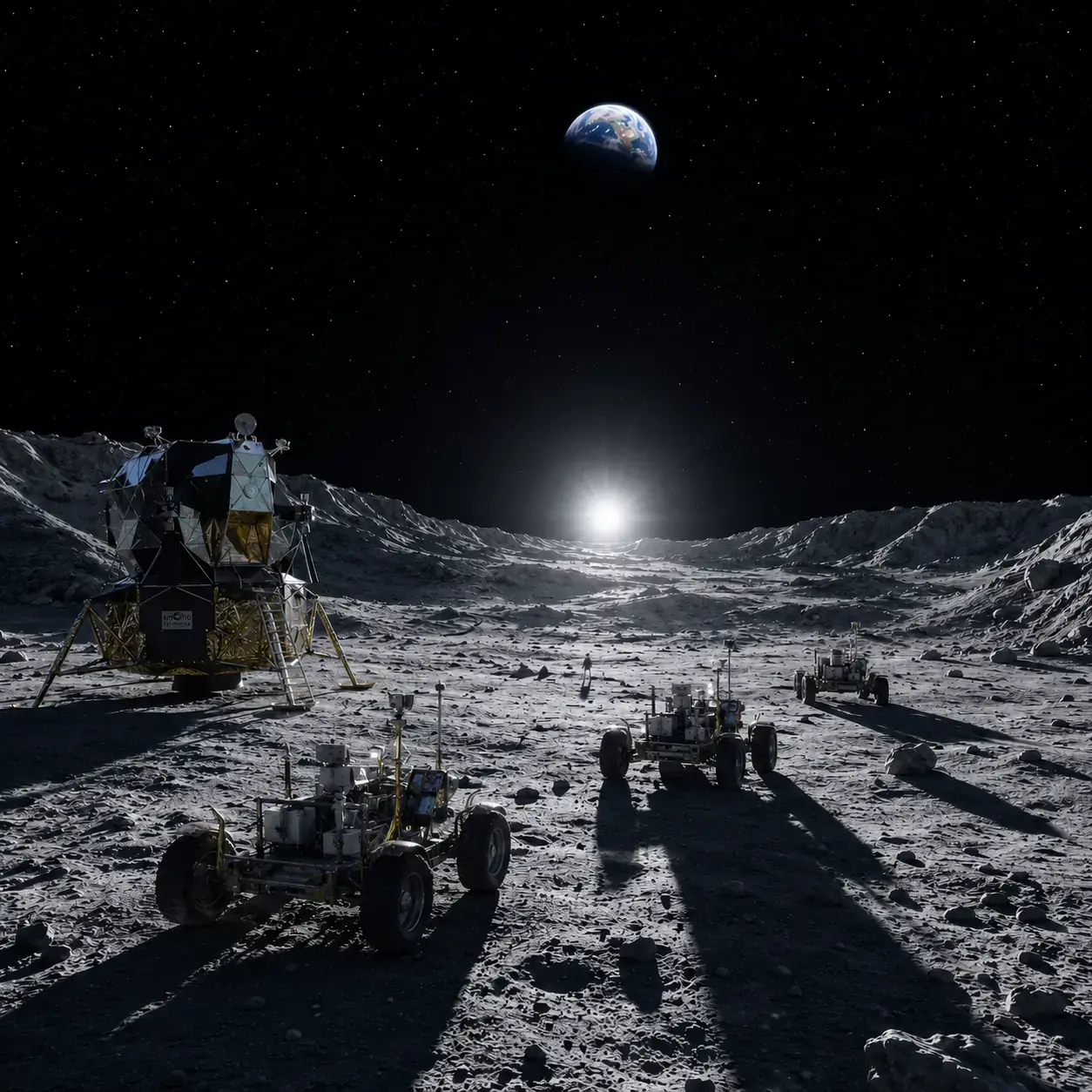
Lunar Rover Mission Simulation:
Mission 001 archive
Mission 001 was designed as a two-hour live simulation at the lunar South Pole, with mission terrain, live telemetry, and operational decisions under pressure. The event date has passed; this page records the format and scenarios.
A rover is waiting on the surface.
The simulated lander is down at 87° South — lunar South Pole terrain, where missions study the search for water ice. The rover has rolled off the ramp. Mission control is live, five other commanders are on the loop, and Flight is waiting for the next status report.
For the next two hours the simulation is operated as a mission: drive across lunar terrain, read telemetry, follow health checks and GO/NOGO discipline, call anomalies, capture a simulated elemental spectrum, and fly a survey grid around a possible water-ice signal.
A controlled failure is part of the scenario. Diagnosing it and recovering with the crew turns procedures into operational judgment.
The result is practical familiarity with how a lunar rover mission is operated: through a console, a voice loop, telemetry, procedures, and decisions.
Two scenarios. One evening.
First Steps on the Moon
Health check. First drive. Approach a science target and capture an elemental spectrum of lunar rock with your APXS instrument. You learn the console, the comms discipline, and what it feels like when Flight finally gives you GO.
First Discovery
Fly a survey grid with your neutron spectrometer and watch the counts climb — hydrogen means water ice. Pinpoint the signal, mark the site, claim the discovery. Mid-survey, mission control injects a live anomaly. Notice it. Call it. Recover.
Mission timeline
Mission 001 included:
One of six command seats — your own rover, your own console, your callsign on the voice loop
Pre-mission briefing pack — your operator training (~1 hour: mission, rover systems, console, procedures), sent on registration
2-hour live mission with two facilitators running mission control
A live anomaly injected during your mission — the controlled-failure training real operators get
Full mission recording delivered within 48 hours
Mission 001 certificate with your name and callsign
Debrief & Q&A with the engineers building LunCoSim and the Lunar Open Robotics Standard (LORS)
Founding crew status — named in the mission log, alumni pricing on all future missions
The mission format combined a briefing pack, two-hour live operation, anomaly scenario, recording, debrief, and certificate.
Ask about future missionsThe people running the loop

Rod Mamin
Flight Director
Rod Mamin is a space systems engineer and the founder of LunCo. He led the development of Asagumo, the first walking rover designed for the Moon, and trained as a lunar rover operator through Astrobotic — putting him in the rare group of people who have both built Moon-bound hardware and been certified to drive it. Today he leads LunCoSim and the Lunar Open Robotics Standard (LORS), bringing professional mission-design tools into the open. On mission day, Rod runs the loop: he holds GO/NOGO authority, owns the timeline, and makes the calls. Whatever breaks is his doing — and yours to fix.

Rina Faber
Mission Scientist
Rina Faber is a planetary scientist and co-founder of LunCo, with a research career spanning Moon/Mars mineralogy, space medicine, and rover instrumentation. She trained on ESA's ExoMars program, developing calibration and analysis methods for the rover's infrared spectrometer, and maps planetary surfaces using hyperspectral data and deep learning. Her space-medicine work — lunar dust toxicity, radiation effects, cosmonaut health — means she understands not just what the Moon hides, but how it fights back. Rina designed this mission's science: the South Pole exploration profile, the rock spectroscopy, the water-ice survey. On the loop she's SCIENCE — interpreting your data live and telling you what your rover just discovered.
The simulator behind Mission 001
The mission runs on LunCoSim, our open-source collaborative space-mission simulator: a shared, real-time 3D lunar environment where multiple participants operate rovers simultaneously, with physics-based locomotion and live mission-control telemetry. The code is public: inspect it, star it, contribute to it — then fly a mission on it.
Is this a real rover on the Moon?
No — it's a high-fidelity simulation of a realistic mission profile. The terrain, telemetry, procedures, teamwork, and pressure are as real as we can make them. That's the point: this is how real operators train, too.
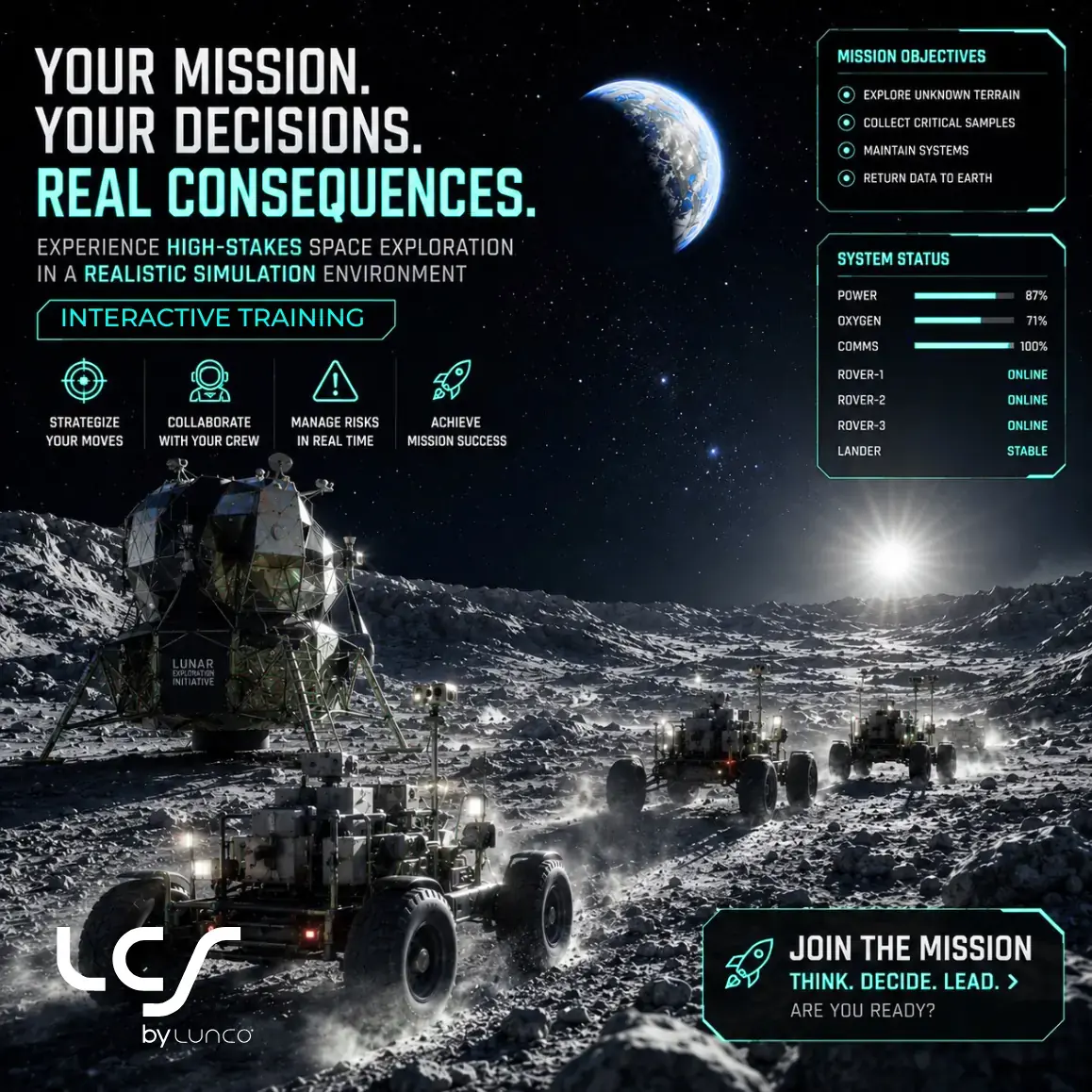
No space background required
A regular computer, a headset and a checklist are enough to fly this mission. The briefing pack covers the essentials in under an hour, the first 15 minutes are guided practice, and mission control stays on the loop throughout.
Space enthusiasts who want to know what rover ops actually feel like
Students & early-career scientists and engineers curious about mission operations
Gamers and sim fans ready for something real underneath the experience
Anyone who's watched a landing livestream and thought: I want to be on that loop
Mission setup: a computer (Windows / Linux / modern browser) · stable internet · headset with microphone · ~1 hour for the briefing pack before mission day.
From checkout to touchdown
Register
Future sessions will publish their dates and registration details here.
Get your briefing pack
Operator training by email, plus the crew registration form (callsign, tech setup)
Tech check
Short optional session before mission day so your console just works
Fly the mission
2 hours live, then recording + certificate within 48 hours
Full refund up to 7 days before the mission, or free transfer to the next mission — your choice. If we can't complete your mission for technical reasons, you fly the next one free.
Ask about future missionsQuestions, answered
A simulated lunar rover mission
This is a high-fidelity simulation of a realistic mission profile, built on open-source software. The procedures, telemetry, teamwork, and operational pressure are modelled without the several-million-dollar cost of flying hardware.
Designed for first-time operators
The briefing pack teaches the essentials in under an hour, the first 15 minutes of the mission are guided practice, and Flight and Science stay on the loop throughout.
Rover recovery and anomalies
Anomalies are part of the mission. Mission control helps the crew diagnose and recover, because recovery is where operational judgment becomes real.
Required hardware
A regular computer and a headset are enough. No gaming PC is required; a technical check runs before the mission to make sure the console works.
Mission date
Mission 001 was scheduled for 18 July 2026 and is now archived. Contact LunCo for information about future operator sessions.
Changes to attendance
A full refund is available up to 7 days before the mission, or the seat can be transferred to the next mission at no charge.
Simulation contingencies
Contingencies are rehearsed as part of mission operations. If a technical problem prevents completion, the crew receives a free seat on the next mission.
Mission format
Mission 001 used six command seats, two facilitators, a live two-hour operation, custom science content, and a prepared anomaly scenario. Future sessions may use a different format.
Future missions
Mission 001 focused on rover operations. Contact LunCo for information about future mission formats and dates.
MoonDAO relationship
MoonDAO handles checkout and billing, and LunCoSim is developed with support from the MoonDAO community.
Mission 001 is archived.
The format remains available as a reference for future LunCo mission simulations. Contact the team to hear about the next operator session.
Ask about future missionsNot ready to commit? Get the mission date, a free mission-briefing sample, and first access to future missions.
Keep me postedMission 001 was hosted with support from the MoonDAO community